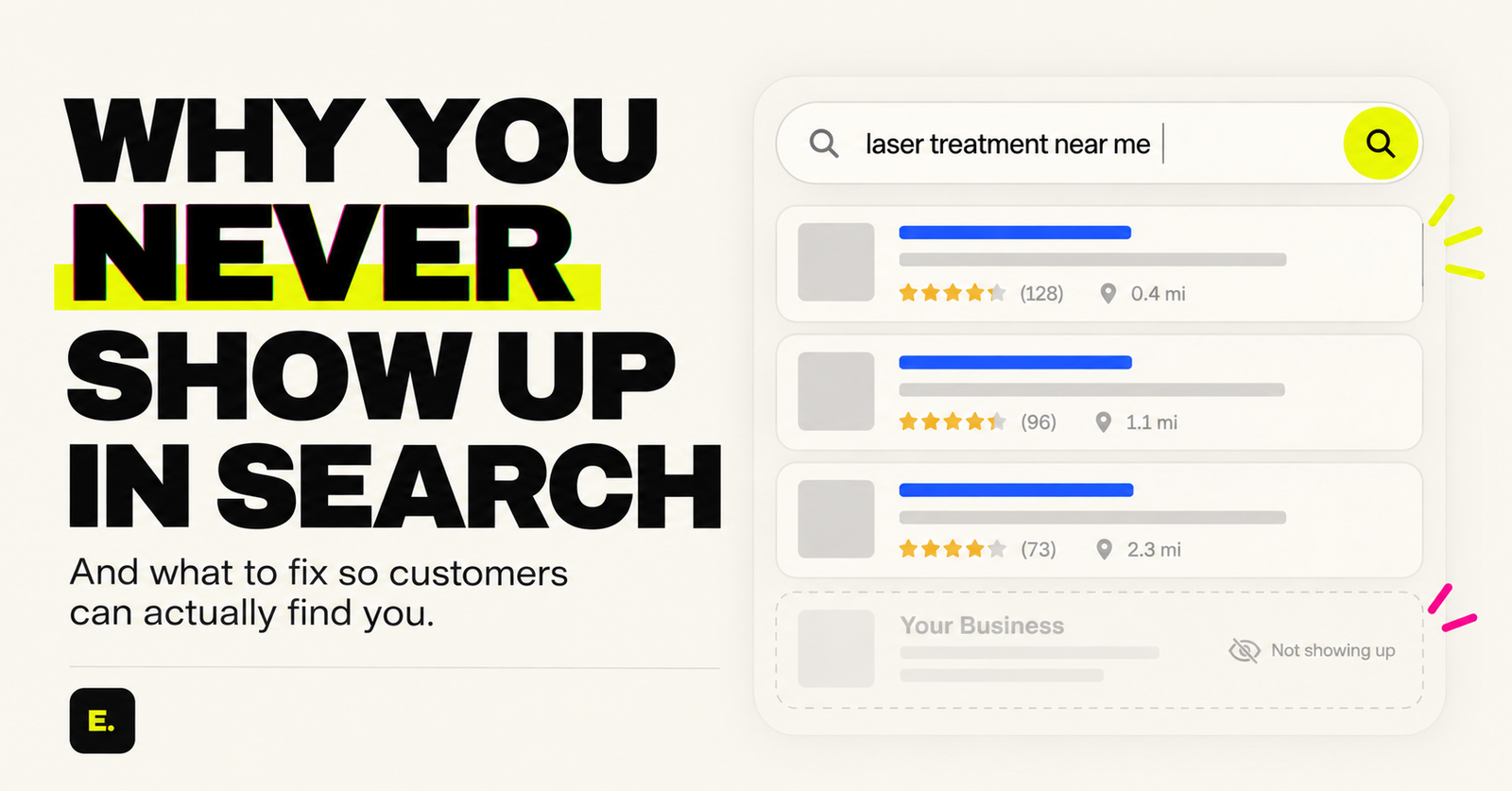
Your customers say they searched and couldn’t find you. You type your name into Google and there you are, right at the top. Both of you are correct, and the gap between the two is costing you jobs.
Written for owners of clinics, salons, studios and local shops in Singapore. Not for SEO agencies.
Key takeaways
- There are two different problems, not one. You are either invisible to Google, or visible but buried under competitors. The fixes have almost nothing in common.
- A one-minute test tells you which. Search your own name, then search what you do. What appears, and what doesn’t, points straight to the cause.
- Where the searcher stands changes the answer. Google Maps re-ranks street by street, so the flattering view from inside your shop is not what a customer across town sees.
- Ranking on Maps and being named by AI are now separate jobs. You can win one and be missing from the other, and most owners have only ever worked on the first.
- The matrix near the end matches your exact symptom to the one action that fixes it.
The one-minute test: invisible, or just buried?
Before you change a single thing, find out which problem you have. Guessing is how owners waste months fixing the wrong one.
Open a private browser window so your own history doesn’t skew the results. Then run two searches from your town or neighbourhood.
- Search your exact business nameIf you do not appear at all, Google either does not know you exist or does not trust your listing. Your profile is unverified, suspended, or was never created. That is an invisibility problem.
- Now search what you do, not who you areTry “chiropractor in Yishun” or “acne scar clinic Tampines” instead of your name. If your name works but your service does not, Google knows you exist and has decided others answer the search better. That is a ranking problem.
Invisible and buried are two different problems with two different fixes.
A business Google can’t see needs to get seen at all. A business it can see but ranks low needs to beat the competitors already doing the basics. Do the wrong one and nothing moves.
Invisible
- Nothing shows, even for your name
- No profile, or unverified, or suspended
- Pin missing from category searches
- Fix: get seen and trusted first
Buried
- Your name works, your service doesn’t
- You sit below competitors
- You appear near your address, vanish further out
- Fix: beat the businesses above you
If you’re invisible: it’s almost always your profile
For a local business, your Google Business Profile carries more weight than your website, your logo or your years in the trade. Indeed, it is where local visibility begins or ends. So when a business is truly missing, the cause is usually sitting right here.
No profile, or an unverified one
A business without a profile is invisible to local search, however good the work. Even a profile that was claimed but never verified is nearly as bad, because Google treats unconfirmed information as unconfirmed. And if you run from home or serve an area rather than a storefront, a visible home address or a misconfigured service area can hide your pin or trigger a suspension, even when everything about you is legitimate.
The wrong category quietly costs you every day
Google leans hard on your primary category to decide which searches you answer. Pick something broad like “health and wellness” instead of “chiropractor” and you weaken every match. Choose the specific thing you actually do. Then fill in the rest: description, services, hours, photos, website link. An incomplete profile reads as lower trust.
The quiet killer: NAP
Your Name, Address and Phone number must match everywhere: profile, website footer, Facebook, directories. When they differ even slightly, Google can’t tell which version is true, and it responds by lowering you rather than guessing. It is one of the most common and most overlooked fixes there is.
Reviews, and staying active
Reviews are not just for customers. In fact, Google reads them as a trust signal, and it weighs recent ones more heavily than an old pile, however large. A profile with fresh reviews and new photos looks alive. By contrast, one left untouched for months looks abandoned, and slips down on its own, without any single mistake.
If you’re buried: how Google picks the top three
Once Google is sure you exist, a different contest begins: who gets shown. Local ranking rests on three things that work together.
- Relevance. How well your profile and website match the words someone actually typed. Category, services listed, and the language on your pages all feed this.
- Distance. How close you are to the searcher. You can’t change your address, but strength in the other two can offset it.
- Prominence. How known and trusted you look online: volume and recency of reviews, mentions across directories, links to your site, and general activity.
Here is the part that stings. In a busy market, a complete profile, a few reviews and a working site are no longer enough, because your competitors have already done all of that. So you are not invisible at all. Instead, you are losing the relevance and prominence contest to businesses that went further. Look at the top three for your main search and note what they have that you don’t. That list, in effect, is your roadmap.
When Google can’t read your website
Sometimes the profile is fine and you still don’t come up for what you do. The problem has moved to the website. This one shows up on “what you do” searches, not on searches for your name.
The pages aren’t indexed
Before a page can rank, Google has to have it on file. Type site:yourdomain.com into Google. If almost nothing comes back, your pages are not indexed, and a page Google hasn’t filed cannot rank for anything.
The causes are usually quiet ones. A stray “noindex” tag a developer forgot to remove. A block in the site’s robots file. Pages so thin or so similar to each other that Google ignores them. Or pages that nothing else links to, so Google never finds a path in.
A two-minute check
Run the site: search above. For a page that should be live but isn’t listed, open Google Search Console and request indexing for that exact address. It asks Google to look now, instead of whenever it next gets around to you.
The pages don’t say what you do
A homepage that only says “Welcome to Your Clinic” gives Google almost nothing to match a search against. It needs to read, in plain words, what you do, who you help, and where. “Acne scar treatment in Tampines” is something Google can place. “Welcome” is not.
Give each main service its own page, and each area you serve its own page. Put the service and the place in the heading and the page title, not buried in one brochure paragraph. And make sure the site is quick and works properly on a phone, because that is where most of these searches happen.
The proximity trap: why you rank at the shop but not across town
This is the one that fools almost everyone. You search your service, see yourself at the top, and assume you’re fine. But Google Maps hyper-localises. As a result, it re-ranks the results based on where the searcher is standing, sometimes down to a few hundred metres.
So the view from inside your own clinic is the most flattering one you will ever get. Rankings fall away the further a customer is from your verified pin, and past a certain distance you drop off the first page completely. A clinic in Novena will rarely show for someone searching in Tampines, no matter how well its profile is built.
Stop testing from your desk
One search from your own address tells you almost nothing. Tools like Local Falcon run the same search from dozens of points across your area and draw a grid: green where you appear, red where you don’t. That map shows your real catchment, not the version you see from your own chair.
The shared-building filter: when your neighbour cancels you out
You did everything right and still vanished from the top three. If you share a building with businesses in your exact category, a medical suite or a mall, this may be why.
When several businesses in the same primary category sit at the same address, Google usually shows only the most prominent one and filters out the rest, so it does not repeat the same building in the results. This is not a penalty. Rather, it is a de-duplication rule, and it can quietly erase you.
The suite-number myth
Adding a unit or floor number rarely gets you past this. The filter looks at the building, not the door. The only reliable way through is to be the most prominent of the businesses at that address: more recent reviews, more mentions on other sites, a fuller profile than the neighbour who keeps winning the slot.
Not sure whether it’s your profile, your proximity, or your neighbour? The free audit checks all of it and shows you exactly what’s happening.
Get My Free Audit ↗When “what you do” shows an AI answer instead of a list
Search your service today, and often the first thing on the page is not a row of businesses. Instead, it is an AI answer that names two or three and moves on. Many people read that, act on it, and never scroll. So if you are not named in it, you are not in the running, even when you rank perfectly fine below it.
This is the split most guides miss. Ranking on Google and being recommended by AI have become two different jobs. A clinic can hold page one and still be absent from a ChatGPT, Gemini or Google AI answer.
AI names the businesses the whole internet agrees on, not the ones that describe themselves well.
One page on your own site is not enough. AI answers are stitched together from directories, press, reviews and guides across many sites. It repeats the names it sees corroborated in more than one place. If the only source describing you is you, there is nothing for it to agree with.
Being named is only half of it
Getting into the answer is the first job. The second is what the answer says about you. The AI does not just list your name, it writes a sentence, and that sentence is stitched together from whatever the internet already says. If the web is thin, out of date, or off-message about you, the description will be too.
So a business can be named and still lose the customer, because the AI called it a budget option, or described a service it stopped offering two years ago. You do not get to write that sentence directly. You shape it the same way you earn the mention: by publishing a clear, current, consistent message in enough places that the AI has something accurate to repeat.
How we know
On 17 September 2026 we searched “the best neck pain specialist” in a private window in Singapore. Doctors, surgeons and hospitals own this search. Google’s AI Overview listed Dr Neck Pain, a chiropractic clinic we work with, second in its options, above a medical pain clinic and a private hospital group.
The guide we published for the clinic that month is one of the sources Google shows beside the answer. That same page also ranks second in the normal results, and no other chiropractor appears on the first two pages. Crucially, the clinic did not outspend the hospitals. Instead, it got published, in many places, on one clear message.
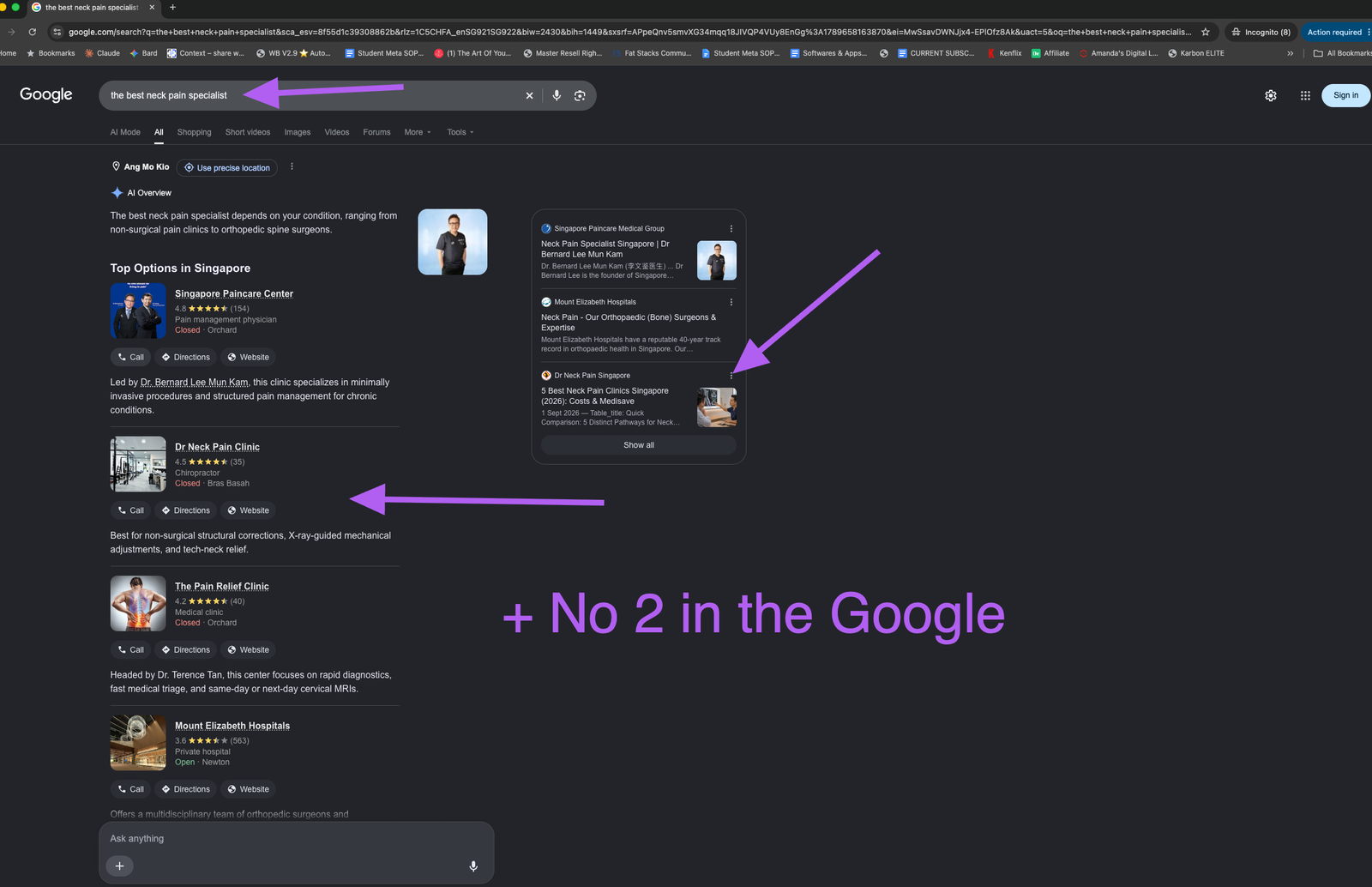
Google search, Singapore, private window, 17 September 2026. The clinic appears in the AI Overview list and among the cited sources.
By the numbers
Why the top of the page is the whole game
- Map packNearly half of all local clicks land on just three businesses, before anyone scrolls to the ordinary results (Backlinko, analysis of local searches).
- The AI shiftThe number one organic click-through rate fell from about 28% to 19% in 2025 as AI answers spread across the top of the page (GrowthSRC, 200,000-keyword study).
- Who asks AIUse of generative AI for local recommendations jumped from 6% to 45% of consumers in a single year (BrightLocal, Local Consumer Review Survey 2026).
- Intent76% of people who run a “near me” search visit a business within a day, so a missed listing is usually a missed customer, not a missed impression (Think with Google).
Read together, these say one thing. A handful of slots at the very top, the map pack and now the AI answer, decide who gets the call. Everyone else splits what’s left.
Your symptom, and what actually fixes it
Everything above comes down to a short table. Find the line that sounds like you, read across, and you have your next move.
Match the symptom to the cause before you spend a dollar on the fix.
| What you’re seeing | What’s really going on | What actually moves it |
|---|---|---|
| Nothing shows, even for your own name | Profile unverified, suspended, or never created | Create and verify the profile; fix the service-area and address settings |
| Your name works, your service doesn’t | Relevance and prominence deficit, not existence | Right primary category, fuller services, and stronger prominence signals |
| Service pages never appear, even for text that’s on them | Pages not indexed, or blocked from Google | Check with a site: search, clear noindex or robots blocks, request indexing in Search Console |
| Visible at your address, gone 1km away | Proximity boundary | Local content and local citations for the areas you actually serve |
| Stuck at #4 to #10 on Maps, never the top three | Review velocity and prominence deficit | A steady flow of recent reviews and richer service descriptions |
| Disappeared overnight after editing your info | Soft suspension or pending re-verification | Check the profile dashboard for flags and re-verify |
| Only one business shows from your building | Shared-address filter | Out-prominence the neighbour; a suite number won’t do it |
| Rank on Maps, absent from the AI answer | No off-page corroboration | Educational coverage published across third-party media, monthly |
Where should you start?
Visibility is only worth chasing if the enquiries you already get are being answered. Four quick questions point you at the right first move.
Interactive
Find your starting point
Whatever your result, don’t guess the order
Each answer points to a different first move, yet they share one starting line: find out where you actually stand before you spend. A two-minute audit, or a short call, settles it.
Questions owners ask
My name shows up fine. Why do customers say they can’t find me?
Because they don’t search your name, they search what you do. You come up for “Your Clinic Name” because Google is matching letters. You may not come up for “acne clinic near me,” which is what a new customer actually types. Run that second search from across town, in a private window, to see what they see.
Does more visibility fix this?
Only if the right thing is broken. If enquiries already sit unanswered at night, more visibility just creates more missed enquiries. Fix the leak first, then pour more in. The quiz above tells you which order applies to you.
Do I need schema or an llms.txt file before AI will notice me?
No. AI tools read the open internet without them. Schema is quick to add and does no harm, so add it if your web person offers. But for a local business it is a small lever. What gets you named is being published in many places, not a file on your own site.
How is being named by AI different from ranking on Google?
They’re two separate jobs now. Ranking gets you the click on Google. Being published widely gets you named in the AI answer that sits above those clicks. You want both, and the second is the one most businesses have never worked on.
ChatGPT mentions us, but describes us wrong. Can that be fixed?
Yes, over time. AI describes you from what the web says about you. When the accurate, current version of your story appears in more places than the old or wrong one, the description catches up. It takes the same publishing work as earning the mention in the first place, which is why being named and being described well are really one job, not two.
I share a medical building with competitors. Is that why I dropped?
Quite possibly. When several businesses in the same category share an address, Google tends to show only the most prominent one. Adding your suite number rarely helps, because the filter looks at the building, not the door. Winning the slot means more recent reviews and more mentions elsewhere than the neighbour currently beating you.
Can I do all of this myself?
The profile fixes, yes. Verify your listing, pick the right category, tidy your NAP, keep reviews fresh. The hard part is the last row of the table: getting published across other people’s sites, every month, so AI has something to agree on. That is the part people hire out.
Find out what the internet says about you.
The free audit checks your profile, your Maps position and what AI names instead of you, then shows you the first thing to fix.
Get My Free Audit ↗References
Primary sources, from Google and OpenAI directly:
- Google. Tips to improve your local ranking on Google (relevance, distance, prominence). Google Business Profile Help. support.google.com
- Google. Resolve duplicate profiles and ownership issues (why listings at the same address get filtered). Google Business Profile Help. support.google.com
- Google. Guidelines for representing your business on Google. Google Business Profile Help. support.google.com
- Google. Find information with AI Overviews in Google Search. Google Search Help. support.google.com
- Google. AI features and your website. Google Search Central. developers.google.com
- OpenAI. ChatGPT search. OpenAI Help Center. help.openai.com
Independent background:
- The Conversation. AI Overviews have transformed Google search: how they work. Academic authors, RMIT University and Queensland University of Technology, June 2025. theconversation.com
Statistics cited above (named in the text, listed here for transparency):
- Think with Google, on near-me search and visit behaviour.
- Backlinko, analysis of local search click distribution.
- GrowthSRC, 200,000-keyword click-through study, 2025.
- BrightLocal, Local Consumer Review Survey 2026.
Results vary by market and business. Google and AI engines change how they rank and source without notice; the method is to diagnose the real gap and keep publishing, not to chase one answer.